How the Knife Moves: The Hidden Geometry Shaping Every Bite of Sushi
There is a moment familiar to anyone who has sat before a skilled sushi chef—a single piece placed before you, unadorned, seemingly simple. You eat it. Something is unmistakably right about it. The texture yields without resistance; the flavor arrives in sequence rather than all at once; the fish seems almost to dissolve rather than break apart. You reach for the next piece and the experience repeats, each one a quiet confirmation that something deliberate is happening behind the counter.
What most diners cannot articulate is that much of what they are sensing has already been decided before the fish ever touches the rice. It was decided the moment the knife began to move.
Anatomy of a Cut
To understand why knife geometry matters, it helps to think about fish not as a uniform material but as a structured one. Every species—whether bluefin tuna, yellowtail, or flounder—has a distinct arrangement of muscle fibers, connective tissue, and fat deposits. These structures run in specific directions, and the angle at which a blade intersects them determines whether those fibers are cleanly separated or torn.
A clean separation leaves the cellular walls of the fish intact. Flavor compounds remain concentrated within the tissue rather than bleeding out across the cut surface. Fat is distributed rather than smeared. When that piece reaches your palate, the muscle fibers release in sequence, producing what experienced diners describe as a layered or lingering quality to the flavor.
A torn or compressed cut does the opposite. Pressure from an imprecise blade crushes the tissue, releasing moisture prematurely, redistributing fat unevenly, and leaving a surface texture that the tongue reads as either too soft or slightly gummy. The flavor arrives flat—present, but without dimension.
This is not a marginal difference. It is, in many ways, the difference between sushi that tastes merely fresh and sushi that tastes alive.
The Angle Question
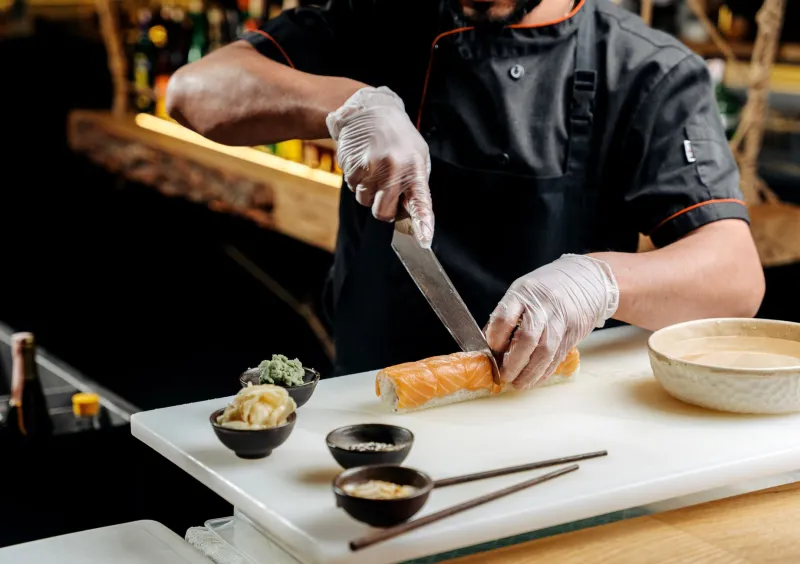
Among the variables a sushi chef controls, cutting angle is perhaps the most consequential and the least visible to observers at the counter. Most premium cuts are made on a diagonal relative to the fish's muscle grain—a technique known in Japanese kitchens as sogi-giri, or oblique slicing. This approach accomplishes several things simultaneously.
By cutting across the grain at a specific angle, the chef increases the surface area of each slice without increasing its thickness. More surface area means more direct contact between the fish and the seasoned rice beneath it, allowing the mild acidity of the shari to interact with the fish's proteins more evenly. It also means that each bite presents a greater ratio of interior flesh to exterior surface, which affects how quickly flavor compounds engage with saliva and, by extension, how quickly taste is perceived.
Adjust that angle by even a few degrees and the geometry shifts. The fibers are now cut at a less favorable orientation; the surface area changes; the way the piece sits on the rice changes. A chef who has spent years calibrating this relationship understands these consequences intuitively. A diner who has never considered them will still register them—as that vague sense that something is slightly off, that the piece didn't quite deliver on what the eye promised.
Thickness and the Temporal Dimension of Taste
If angle governs how flavor is released, thickness governs when. This is a dimension of sushi that rarely enters mainstream conversation in the United States, yet it is one that separates a thoughtful menu from a generic one.
Fatty cuts—toro being the most celebrated example—are typically sliced thinner than leaner ones. The reason is biomechanical: fat melts at body temperature, and a thicker slice of heavily marbled fish will begin dissolving before the diner has fully registered its texture. The experience becomes overwhelmingly rich rather than nuanced. A thinner cut controls the rate of fat release, allowing the diner's palate to move through the experience in stages: first the texture, then the richness, then the clean finish.
Leaner cuts present the inverse logic. A thin slice of, say, flounder or sea bream offers very little fat to carry flavor, and if cut too thinly, the piece simply disappears before it has said anything. These cuts benefit from slightly more mass, which gives the muscle fibers time to release their more subtle compounds against the palate.
A chef who understands this calibrates thickness not by habit or by rote but by reading each specific fish—its fat content that day, its density, how it has aged since arrival. No two fish are identical, and a fixed thickness applied uniformly is itself a form of imprecision.
Direction and the Grain
Beyond angle and thickness, the direction of the stroke itself carries meaning. Japanese knife technique emphasizes drawing the blade through the fish in a single, continuous pull rather than pushing or sawing. This matters because a pull stroke allows the blade's edge to do the work without applying lateral pressure to the tissue on either side of the cut.
When lateral pressure is introduced—even subtly, through an inconsistent stroke—the muscle fibers adjacent to the cut are compressed. They do not separate; they deform. Under the tongue, deformed fibers produce a texture that most diners describe as slightly mealy or dense, a quality that has nothing to do with the fish's freshness and everything to do with how it was handled in the final seconds before service.
This is why the condition of a chef's blade is inseparable from their cutting technique. A razor-sharp edge requires minimal force to travel through tissue, which means the pull stroke can remain clean and unhurried. A dulled edge demands compensation—more pressure, a slight sawing motion, adjustments that introduce exactly the kind of lateral force the technique is designed to avoid. The knife and the hand are not separate instruments. They are a single system, and the quality of the cut reflects the integrity of both.
What American Diners Are Beginning to Recognize
Across the United States, as omakase culture has deepened and premium sushi has moved beyond novelty into genuine connoisseurship, a growing segment of diners is developing the vocabulary to discuss these distinctions. They are learning to notice not just what they taste but how they taste it—the sequence, the texture, the way a piece either opens up or stays closed.
This is an encouraging development, because it creates the conditions for a more honest conversation between chef and guest. When a diner can recognize that a piece of yellowtail has been cut with the grain rather than across it—and can articulate why that changes the experience—they are engaging with sushi at the level its practitioners have always intended.
At Ikeda Osushi, this level of precision is not a point of pride so much as a baseline expectation. Every piece served at this counter begins with a chef who understands that the knife is not merely a tool for portioning fish. It is the instrument through which intention becomes taste. The geometry of each cut is a decision, and every decision shapes what arrives before you.
The fish speaks, but the knife determines what it says.