A Different Kind of Pour: The Craft Behind Non-Alcoholic Pairings at the Omakase Counter

Photo: non-alcoholic tea pairing at upscale sushi counter with ceramic cups and nigiri, via dynamic-media-cdn.tripadvisor.com
At a serious sushi counter, the beverage pairing is never an afterthought. It is a second sequence running alongside the first: one piece of fish, one sip, one small adjustment of the palate. For years that sequence was built around sake, and often wine. In 2026, a growing number of American diners are asking for another option, not because they are indifferent to pairing but because they want the full architecture of the meal without alcohol.
That shift has produced a more thoughtful category of non-alcoholic service. The best programs are not pitchers of sweet tea or sparkling water with a lime wedge. They are designed pairings, built from aged teas, koji-based infusions, vinegar-based shrubs, and sparkling botanicals. At their best, they ask the same questions a chef asks of any ingredient: What does this contribute? Where does it belong? What does it leave behind?
A Pairing, Not a Placeholder
The first distinction worth making is between a non-alcoholic drink list and a non-alcoholic pairing. A list offers choices. A pairing offers a sequence. At a premium counter, the sequence matters because the meal is already a progression: lean white fish, richer fish, shellfish, perhaps a piece of fatty tuna, then something cured, grilled, or lightly simmered. Each course changes the palate. A well-built pairing follows that arc rather than fighting it.
Chefs designing such a sequence think in terms of weight, acidity, aroma, texture, temperature, and finish. A delicate opening course may call for a pale, lightly steeped tea or a citrus-forward botanical pour. A richer bite may need something with more body, perhaps an aged tea or a koji-based infusion with a savory edge. A fatty course often benefits from acidity, which is where shrubs and vinegar-based preparations earn their place. Carbonation can provide lift, but too much can make the palate busy. Sweetness can round a harsh edge, but too much can flatten the next bite.
The same sourcing discipline that guides a premium sushi counter—seasonality, restraint, and respect for the ingredient—applies to the glass. Tea is harvested, blended, and aged with care. Koji is cultivated and monitored. Fruit is preserved at its peak. These are not decorative gestures. They are ingredients with their own seasons and their own limitations.
The Ingredients That Carry the Sequence
Aged teas bring depth without alcohol. Hojicha offers a roasted, nutty profile that can sit comfortably beside grilled or cured fish. Older sencha and gyokuro can provide umami and a long finish. The key is extraction: a tea steeped too strongly can overwhelm delicate fish, while a tea steeped too weakly disappears beside richer courses.
Koji-based infusions introduce a savory quality that is especially useful at a sushi counter. Koji is not a flavor in itself so much as a tool for transformation, and when handled with restraint it can create a drink that feels rounded and food-friendly. The risk is heaviness. A koji infusion that is too thick or too sweet will compete with rice and fish rather than support them.
Shrubs, made from vinegar, fruit, and sugar, offer a different kind of structure. Their acidity can cut through fat and refresh the palate between richer bites. At a premium counter, the best shrubs are restrained, with enough vinegar to lift the meal but not so much that the guest tastes only acid. Sparkling botanicals—shiso, yuzu, sansho, cucumber, and similar aromatics—can provide a clean, fragrant lift. They are particularly useful early in a meal, when the palate is still waking up.
Designing the Sequence
A non-alcoholic pairing is built much like a menu. The opening should be light and clarifying. The middle should gain a little weight. The richest courses may call for acidity or a longer finish. The final courses often benefit from something quieter, so the meal does not end on a loud note. Temperature matters as much as flavor. A cool, sparkling pour can refresh; a warm, roasted tea can soothe. Glassware matters too, because aroma is part of the experience.
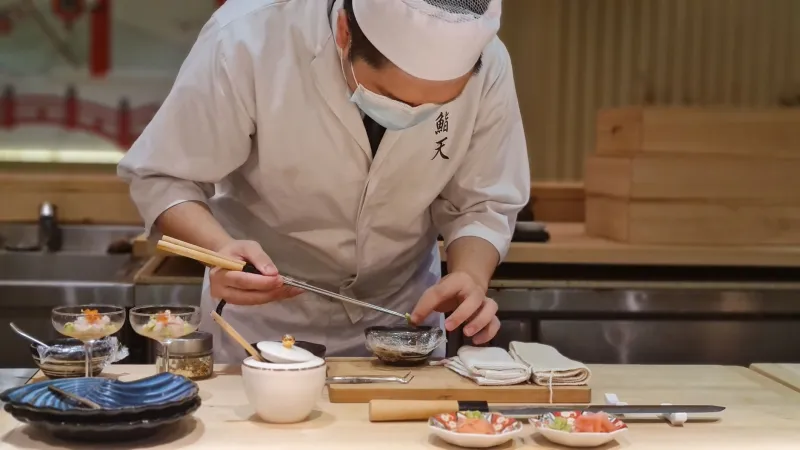
At Ikeda Osushi, the principle is consistent with the kitchen’s broader approach: the beverage should serve the food, not compete with it. That means no automatic assumption that every guest wants the same progression. Some diners want a full pairing. Others want one or two well-chosen glasses. A serious program makes room for both without treating the non-alcoholic guest as an afterthought.
Why It Is Not a Sake Substitute
It is tempting to describe non-alcoholic pairings as sake alternatives, but that language undersells them. Sake has its own amino acids, aromatics, and brewing history. A tea or shrub is not trying to imitate sake. It is trying to do a different job: provide contrast, cleansing, warmth, or lift in its own right.
When a restaurant treats non-alcoholic options as substitutes, the results are usually obvious. The drinks become too sweet, too broad, or too aggressive. When they are treated as their own category, they can be precise. The guest is not being asked to pretend that something is missing. The guest is being offered a different sequence, designed with the same care.
What Diners Should Look For
American diners choosing a non-alcoholic pairing should ask whether it is a designed sequence or an à la carte list. A designed pairing should have a logic to its order. Ask about sweetness, caffeine, acidity, and allergens. Ask whether the pairing can be adjusted for dietary needs or preferences. Ask how many pours are included and whether the pace matches the meal.
It is also reasonable to ask for a small taste before committing to a full pairing, especially at the counter. A good service team will not treat that request as suspicion. It is simply part of ordering well. The goal is not to replicate the experience of drinking alcohol. The goal is to make the meal complete, considered, and pleasurable from the first sip to the last.