From Light to Rich: A Chef's Guide to Navigating the Sushi Menu

Photo by Photo by Lucas Law on Unsplash on Unsplash
Walking into a premium sushi restaurant for the first time can feel disorienting. The menu may offer dozens of options with little apparent hierarchy, and without guidance, most diners default to ordering their favorites in no particular sequence. The result is often a meal that starts with fatty tuna, circles back to something light, and ends without any clear sense of culmination.
At Ikeda Osushi, the menu is structured with intention. Every piece has a place in a larger arc, and understanding that arc—even loosely—allows diners to engage with their meal the way a chef intends. What follows is a practical framework for reading a sushi menu not as a catalog, but as a composition.
The Principle of Progressive Richness
The foundational rule of traditional sushi sequencing is elegantly simple: begin with restraint, build toward richness, and close with purpose. This mirrors classical dining philosophy across many culinary traditions, but in the context of Japanese cuisine, it carries particular precision.
The palate, at the start of a meal, is receptive and uncoated. Delicate flavors register fully. As the meal progresses, the palate accumulates fat, salt, and umami—and the fish presented must be substantial enough to hold their own against that accumulating context. A piece of flounder served after otoro would be nearly invisible. Presented first, it is revelatory.
This is not an abstract principle. It has direct implications for how diners should approach ordering at any premium sushi establishment.
Course One: The White Fish Foundation
The opening of a well-sequenced sushi meal typically belongs to white-fleshed fish—shiromi. Varieties such as flounder (hirame), sea bream (tai), and fluke occupy this position because their flavor profiles are clean, subtle, and structurally transparent. They ask the palate to pay close attention.
At this stage, the rice itself becomes more perceptible. The seasoning of the shari, the texture of each grain, the faint acidity of the vinegar—these qualities register most clearly when they are not competing with a heavily marbled or assertively flavored fish. For diners at Ikeda, the first pieces served are an invitation to calibrate: to settle into the experience, to taste the rice as a component rather than a vehicle, and to prepare the palate for what follows.
A practical note for American diners: resist the impulse to reach immediately for salmon or tuna. The restraint of the opening course pays dividends later in the meal.
Course Two: The Middle Register
Following the white fish, a well-composed progression moves into what might be described as the middle register—fish with more defined flavor, moderate fat content, and greater textural complexity. This tier commonly includes yellowtail (hamachi), striped bass, and certain preparations of snapper.
These pieces serve a transitional function. They carry enough presence to satisfy a palate that has been primed by the opening course, while stopping short of the full richness that characterizes the meal's peak. Shellfish—particularly scallop, shrimp, and clam—often appear at this stage as well, offering textural contrast and a different expression of oceanic flavor.
Seasoned diners at premium establishments frequently describe this portion of the meal as its most intellectually engaging. The flavors are complex enough to reward attention, but not so dominant that they overwhelm the palate's capacity for discernment.
Course Three: The Apex — Fatty Fish and Aged Preparations
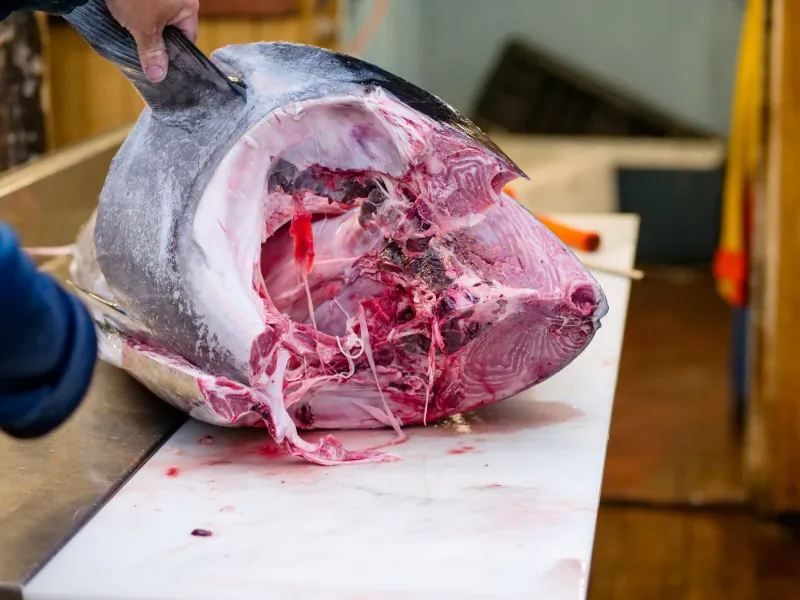
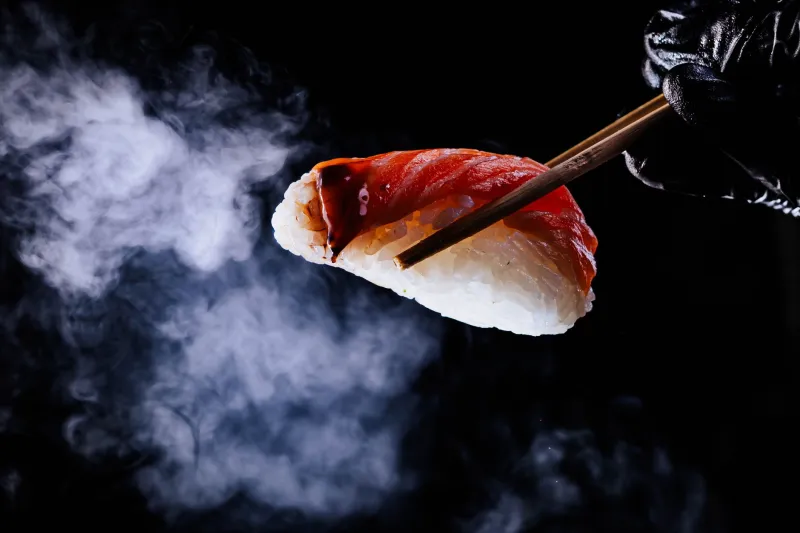
The meal's peak is typically marked by the arrival of richer, more luxurious cuts. Fatty tuna (toro and otoro), salmon with its characteristic marbling, and aged preparations of fish that have been allowed to develop deeper umami through controlled rest—these are the pieces that anchor the experience.
At Ikeda Osushi, sourcing at this tier is treated with particular rigor. The fatty tuna served here is selected based on the fat distribution within each loin, not simply the cut designation. The distinction between chutoro and otoro is not merely one of fat content—it reflects where along the fish's belly the flesh was harvested, and how that specific location affects the way the fat melts against the warmth of the rice.
For diners ordering à la carte rather than following an omakase progression, this is the appropriate moment to request these premium cuts. Ordering them earlier—before the palate has built toward richness—diminishes their impact considerably.
Course Four: Cooked and Prepared Items
Many diners are surprised to learn that cooked preparations—braised eel (unagi), tamago (the sweet, layered egg custard), and certain shellfish preparations—are not beginner options or afterthoughts. In traditional sequencing, they often appear toward the end of the raw fish progression as deliberate transitional elements.
Tamago, in particular, functions as a palate-cleansing bridge between the peak of the raw fish sequence and the meal's close. Its sweetness and density provide contrast, and at many traditional establishments, it is considered a quiet benchmark of the kitchen's technical standards—a piece that reveals the chef's control over temperature, timing, and balance in a form that requires no exceptional ingredient to execute.
Course Five: The Close
A traditional sushi meal often concludes with either a hand roll (temaki)—typically tuna or natto—or a maki roll that incorporates multiple elements into a single, cohesive bite. This closing piece functions as punctuation: it brings the meal's accumulated flavors together and signals completion.
For diners at Ikeda, miso soup, when offered, is best received at this stage rather than at the meal's opening. Contrary to American dining conventions, consuming it early can dull the palate's sensitivity before the more nuanced pieces have been presented.
Applying This Framework at Ikeda
Not every meal at a sushi restaurant follows this sequence with rigid formality. Omakase dining—in which the chef selects and sequences every piece—is the most direct expression of this philosophy, and it is the format in which Ikeda's kitchen operates with the greatest creative latitude.
For those ordering from the menu directly, the framework above offers a reliable guide. Begin light, build deliberately, allow the richer pieces to arrive when the palate is prepared to receive them, and close with intention. The meal that results will bear little resemblance to one assembled by impulse alone—and the difference will be immediately apparent from the first bite.