Pressure, Temperature, and Mastery: What Your Hands Reveal About a Sushi Chef's Training
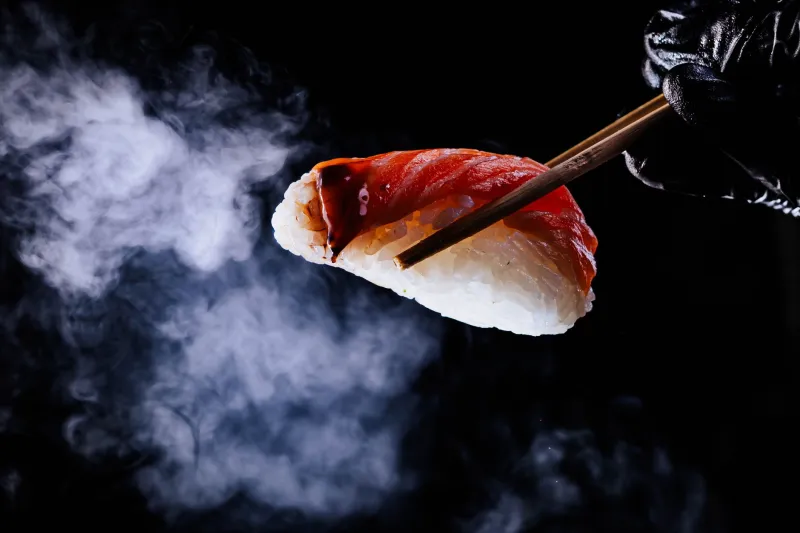
Nigiri sushi appears deceptively simple — a mound of rice, a slice of fish, and nothing more. Yet within that minimalism lies decades of disciplined practice, where the pressure of a chef's palm and the temperature of their hands determine the difference between transcendence and mediocrity. At Ikeda Osushi, this foundational craft is not merely respected; it is rigorously upheld.
The Illusion of Simplicity
Walk into any grocery store in the United States today and you will find pre-packaged nigiri sitting beneath fluorescent lights, each piece uniform and lifeless. The fish rests on compressed rice, technically assembled but entirely soulless. For the uninitiated American diner, this may seem a reasonable approximation of the real thing. It is not.
Authentic nigiri — the kind practiced in Tokyo's oldest sushiya and honored at establishments like Ikeda Osushi — is a living negotiation between chef and ingredient. Every piece is formed in real time, shaped by hands that have spent years learning to listen to the rice, to feel the fish, and to deliver a result that dissolves coherently on the palate rather than collapsing into separate, disconnected components.
The word nigiri itself derives from the Japanese verb nigiru, meaning to grip or to squeeze. That etymology is instructive. The action is not passive placement. It is an intentional, calibrated application of force — and that force is everything.
What Traditional Japanese Training Actually Demands
In Japan, the path to becoming a sushi chef is notoriously demanding. Apprentices in traditional establishments, known as itamae, often spend their first year doing nothing more than observing and cleaning. The second year may introduce rice preparation — and only rice preparation. The logic is ancient and deliberate: before a chef can form nigiri, they must understand rice at a cellular level.
Japanese sushi rice, or shari, is not simply cooked grain seasoned with vinegar. It is a precisely calibrated medium. The temperature at the moment of shaping must hover around body heat — approximately 98 degrees Fahrenheit — because rice that is too cold becomes dense and unyielding, while rice that is too warm turns mushy and loses structural integrity. An experienced chef maintains this window intuitively, adjusting their pace and technique throughout a service.
Beyond temperature, the number of times a chef presses the rice matters enormously. Traditional training teaches that nigiri should be formed in three distinct motions, each serving a different structural purpose: the initial shaping of the rice body, the compression of the fish against it, and the final turn that seals the form without crushing the air pockets that give the rice its characteristic lightness. Those air pockets are not incidental — they are the mechanism by which the rice dissolves gracefully the moment it meets the warmth of your mouth.
The Hand as an Instrument
Perhaps the most overlooked element of nigiri craftsmanship is the chef's hand temperature itself. Some chefs naturally run warmer than others, and this physiological reality requires constant compensation. A chef with warm hands must work faster, keeping contact with the rice brief to avoid prematurely softening it. A chef with cooler hands has slightly more time but must apply marginally more pressure to ensure cohesion.
At Ikeda Osushi, our chefs are trained to be acutely aware of their own physical tendencies. This self-knowledge is not vanity — it is precision. In the same way that a surgeon understands the natural steadiness of their dominant hand, a sushi chef must internalize the unique characteristics they bring to each piece they form.
This is also why nigiri cannot be replicated by machines. Automated sushi-forming equipment, common in mass-production facilities, applies identical pressure to every piece regardless of the fish's texture, the rice's moisture content on a given day, or the ambient humidity in the kitchen. A human chef makes hundreds of micro-adjustments per service. A machine makes none.
Why American Diners Often Miss the Point
The American dining culture has, understandably, been shaped by accessibility and convenience. Sushi arrived in the United States in the 1960s and expanded rapidly through the 1980s and 1990s, largely through Americanized formats — rolls heavy with cream cheese and avocado, spicy mayo drizzled liberally, and portions scaled for abundance rather than refinement. These adaptations have genuine cultural value, and there is nothing inherently wrong with enjoying them.
However, they have conditioned many diners to evaluate sushi primarily through the lens of flavor intensity and volume rather than technique and restraint. Nigiri, by contrast, demands the opposite orientation. Its pleasures are subtle. The reward is not in a burst of competing flavors but in the seamless integration of two ingredients — rice and fish — that have been brought into perfect alignment by a skilled hand.
When American diners encounter authentic nigiri for the first time, the reaction is often one of quiet surprise. It does not announce itself loudly. It simply feels right in a way that is difficult to articulate but immediately recognizable.
How Ikeda Osushi Honors the Tradition
At Ikeda Osushi, every piece of nigiri served is formed to order by chefs whose training reflects the traditional Japanese itamae model. Our kitchen does not pre-form pieces during prep and hold them under refrigeration, a common shortcut that sacrifices both texture and temperature integrity. Instead, each order initiates the process fresh.
Our chefs work with shari that is prepared in small batches throughout the day, ensuring the rice never drifts too far from its ideal temperature window. The fish is sliced immediately before plating, not hours in advance, preserving its surface moisture and natural oils — both of which contribute to how the piece coheres in the hand and on the palate.
This commitment adds time and labor to our operation. We consider it non-negotiable. The difference between nigiri formed with genuine mastery and nigiri assembled without it is not theoretical — it is something every guest can taste, feel, and remember.
An Invitation to Experience the Difference
For diners who have grown accustomed to sushi as a casual, accessible meal, we extend a genuine invitation: approach nigiri with curiosity rather than familiarity. Notice how the rice holds together without feeling compacted. Observe whether the fish and rice seem to belong to each other or merely coexist. Pay attention to how quickly — and how cleanly — the piece resolves on your palate.
These are not esoteric pleasures reserved for connoisseurs. They are the natural rewards of craft executed at its highest level. At Ikeda Osushi, we believe every guest deserves to experience them — and we have built our kitchen around the discipline required to deliver them, one piece at a time.