Seated, Uncertain, and About to Have the Best Meal of Your Life
Let us begin with an honest admission: the first time most American diners sit down at an omakase counter, they are carrying a considerable amount of invisible luggage. There are questions they have not asked anyone, concerns they have not articulated even to their dining companion, and a low-grade anxiety that has been building since the reservation was made weeks ago.
This is entirely normal. It is also, in the experience of those who work behind the counter at Ikeda Osushi, one of the most reliably transformative states a diner can arrive in — because the anxiety, once released, creates space for something genuinely extraordinary.
What follows is an attempt to address those unspoken concerns directly, with the candor they deserve.
"I Don't Know Enough"
This is, statistically speaking, the most common anxiety among first-time omakase diners, and it is the one most worth dismantling immediately. The omakase format was not designed for experts. It was designed to remove the burden of expertise from the diner entirely.
The word itself — omakase — translates roughly as "I leave it to you." It is an act of delegation, not a test of knowledge. When you sit at the counter at Ikeda Osushi, you are not expected to identify each fish by its Japanese name, to comment intelligently on the aging technique, or to demonstrate any particular familiarity with regional sushi traditions. You are expected only to be present and attentive.
The chef is not evaluating your credentials. He is reading your responses — the way your expression changes when a flavor lands, whether you reach for water after a particularly rich piece, how quickly or slowly you pace yourself. These are the signals that guide the progression of the meal. They require no vocabulary at all.
"What If I Don't Like Something?"
This concern deserves a two-part answer. The first part is practical: before service begins, the team at Ikeda Osushi will ask about dietary restrictions and genuine aversions. This is not a formality. It is how the kitchen ensures that the evening proceeds without genuine discomfort. If there is something you cannot eat — for medical, religious, or deeply personal reasons — say so. The information will be accommodated without judgment or inconvenience.
The second part of the answer is more philosophical. The omakase counter is a place where many diners encounter flavors and textures they have not previously experienced. Some of those encounters will be immediately pleasurable. Others will require a moment of adjustment. A few may genuinely not suit your palate.
None of this constitutes failure. The tradition of counter dining in Japan was built on the understanding that not every course will produce the same response in every diner. What matters is the engagement — the willingness to meet each piece on its own terms before deciding how you feel about it. That openness, more than any prior knowledge, is what makes the experience work.
"Is There a Right Way to Eat This?"
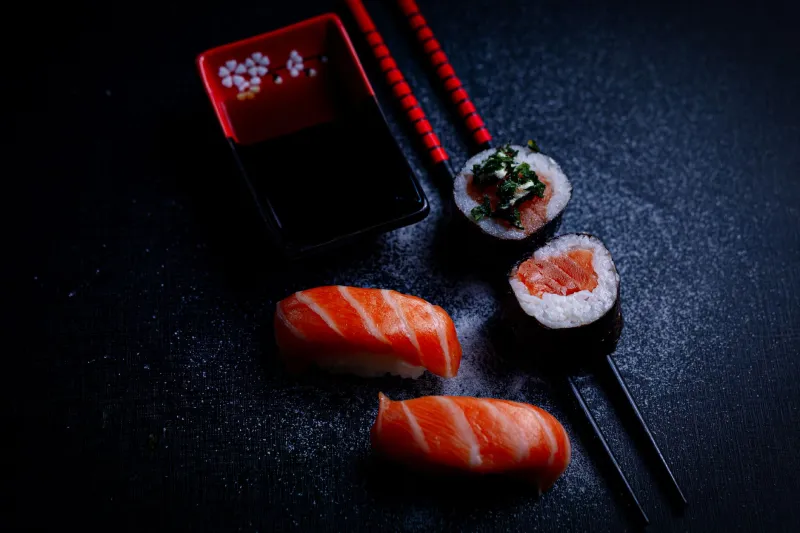
The short answer is: less than you think. Nigiri can be eaten with the fingers or with chopsticks — both are entirely acceptable, and both have historical precedent in Japanese dining culture. The piece should be consumed in one or two bites, not because of rigid etiquette but because the chef has constructed it to be experienced whole, with the ratio of fish to rice calibrated for exactly that purpose.
Soy sauce, if offered, should be applied sparingly and to the fish rather than the rice — the rice will absorb the liquid and collapse the structural integrity of the piece. Wasabi, at a counter like Ikeda Osushi, is typically incorporated directly into the nigiri rather than served as a side condiment, because the chef has already determined the appropriate quantity and placement.
Beyond these practical points, the etiquette of omakase is less about rules than about attentiveness. Eat when the piece is served, not several minutes later. Engage with the chef if conversation arises naturally, but do not feel obligated to perform enthusiasm. The counter rewards genuine presence more than any particular behavior.
"The Price Is Making Me Anxious"
Premium omakase dining in the United States represents a significant financial commitment, and it would be disingenuous to suggest otherwise. The price anxiety that many diners experience is real and understandable.
What is worth reframing, however, is the basis of comparison. Omakase is not an expensive version of a standard restaurant meal. It is a fundamentally different category of experience — one that includes not just food and beverage but the extended, undivided attention of a highly trained chef, access to ingredients that are difficult to source and require exceptional skill to prepare, and a pacing that allows genuine appreciation rather than efficient consumption.
When the cost is measured against those components rather than against the per-plate economics of a casual dinner, the value proposition shifts considerably. Many diners who approach an omakase reservation with price anxiety leave having felt, for the first time, that they genuinely understood what they were paying for.
"What If I'm Underdressed? Overdressed? Out of Place?"
Ikeda Osushi is a refined environment, and a degree of sartorial consideration is appropriate. Business casual to smart casual attire reflects the spirit of the space without requiring formal dress. Strong fragrances are worth avoiding — not as a rule, but as a courtesy to fellow diners and to the subtlety of the flavors being served.
But the deeper question behind the wardrobe concern is often about belonging: whether a particular diner is the right kind of person for this kind of experience. The answer, without qualification, is yes. The counter at Ikeda Osushi has hosted first-time omakase diners alongside regulars who have been coming for years. What unites them is not sophistication or background but curiosity — the willingness to sit down, surrender the menu, and see what happens.
The Vulnerability That Opens Everything
There is something genuinely unusual about the omakase format that no amount of preparatory reading fully conveys. Surrendering the menu — giving up the control that most American diners exercise as a matter of course — creates a specific kind of openness that is difficult to achieve any other way.
When you cannot choose, you cannot default to the familiar. When you cannot default to the familiar, you encounter things you would not have ordered. When you encounter things you would not have ordered, you sometimes discover that your preferences were more limited than your palate.
This is not a sales pitch for discomfort. It is an observation about what happens when experienced diners reflect on their first omakase meal. Almost universally, the moment they remember most vividly is not the piece they expected to love. It is the one that surprised them.
The anxiety you feel before sitting down at the Ikeda Osushi counter is not an obstacle to the experience. It is, in a quiet way, the beginning of it.